Monday, July 5, 2010

Winterthur 2010 Attendance List


As many already know, "Proud To Be Italian" day at Winterthur turned out to be a huge success. Frank and I (as well as the staff at Winterthur) were very pleased with all who'd taken the time out of their already short-and-packed weekend agendas, to come and see all that we'd worked to put together.


In the midst of the event, my mother, Marianne (Salvo) Brady, thought it might be a good idea to place a "sign-in" sheet on the exhibit display table, to help in capturing the names of some of the many who'd come out to Winterthur for the day. After finding out about what she had done, I was so happy to see that my mother had taken the initiative to do this. There were so many people present for the event whom I'd never met before, and I feel that this list really helped in being able to capture a glimpse of the many who helped in making this event so memorable.


Although these sheets do not include all of the individuals who came out that day, I wanted to pay tribute to those who had taken the time to jot their names down for us. Hopefully after you signed, you were able to get a piece of the Torrone too! (click on the image to see it in enlarged form)

Life at Vicari


Up the winding road about a mile past his father’s farm at Barbiella, my great-grandfather Rosaio would have arrived at ra ca deŕ Vicoŕi (località Vicari) and the home of the Buschiazzo family. In those days, it was common for young adults – and even children – to leave the family home to go to work on the farm of a neighboring family. The work was generally unpaid, but it alleviated the burden on the family when children could be sent to live with a neighboring family, where they would “earn their keep” by helping out on the farm. Times were much different in the days of our grandparents and great-grandparents; families did whatever was necessary to survive. My great-grandfather went to work on the farm at Vicari as a young boy.

Località Vicari is located northwest of the center of Giusvalla – the farm would have consisted of perhaps two cleared acres among the heavily forested hills. The road that led from the “strada provinciale” to Vicari was dirt (it still is today), one would pass the small farm and the Ca’d Tunòn at Barbiella to the right while making the way to Vicari. My great-grandfather’s father Tunòn was considered extremely fortunate, his farm at Barbiella included “duj bùi” – two large steer – so he did not have to till the rocky soil of his farm by hand. I bùi ‘d Tunòn came to him by way of a tumultuous agreement he reached with his brother Gianòn in settling their late father’s estate – Tunòn got the steer and Gianòn got the small house off the main road. It is said that Tunòn got the better end of that deal.

Like all the farms in Giusvalla, the Buschiazzo farm at Vicari was modest and hardscrabble. The small family home was a field stone and wood beam structure – one level – consisting of a kitchen and perhaps two bedrooms. There may have been a tiny root cellar or cold shed beneath the house. There was of course, no running water – it was taken from a nearby spring or stream. There was a small stone barn where the cow, pig and goat were kept – if the family was fortunate enough to have them. This is where my great-grandfather and any other farm hands would have slept as well. The Buschiazzo house maid, Lucia Ancili, would have slept in the main house, probably in the kitchen.

The main crops in Giusvalla at the time were granturco (corn) and fieno (hay). My great-grandfather helped with the tilling of the fields – the Buschiazzo family did not have any “bùi” so this was done by hand – then the planting and harvesting. The family also kept a garden, fruit trees and of course the beloved “cashtagne.” The families in Giusvalla tried their best to preserve enough of the harvest to last through the long and cold winters there. This was not an easy task. If the family was lucky enough to have a pig, it would be slaughtered near harvest time and the meat would be cured or made into sotìzza and stored in the cold shed. Every bit of the pig was utilized in some way, they wasted nothing. The men would hunt wild boar and deer in the abundant boschi throughout Giusvalla in order to help put a little meat on the table. Portabello and porcini mushrooms would have been another staple, harvested throughout the summer in Giusvalla’s abundant forests and dried in the sun to preserve them for future use. Many a meal would have been made of polenta with mushrooms. If the harvest was bad, or there was no pig that year, or the winter lingered a bit too long – or the family did not prepare adequately – they were in trouble. Malnourishment and even starvation was not uncommon.

It was a terribly difficult existence, but in the midst of it was life and love and friendship. In between the daily chores, my great-grandfather would have enjoyed a few minutes with his friends GioBatta Buschiazzo and Lucia Ancili. GioBatta left the farm at Vicari as a young man, he came to the United States and went to work for the DuPont family in the powder mills. He went back and forth from Italy to the U.S. a couple times over the years before returning permanently to take over the family farm at Vicari. He died there in 1963.

Little Lucia Ancili – like my great-grandfather – went to work on the farm at Vicari as a young girl. She worked in the main house and would have been responsible (among other things) for helping in the kitchen, the washing, the garden – and even the harvest, when everyone came out of the house to help in the fields. When Lucia came to the U.S. in 1912, she went to live with my great-grandfather Rosaio (who came in 1910). She never married and had developed tuberculosis and a deformity on her upper spine, my great-grandfather cared for Lucia until she passed away within a couple years of her arrival here in the U.S.

Life presented new challenges here in America, but a background of hard work and perseverance in Giusvalla prepared our grandparents and great-grandparents for anything. They worked hard and pushed forward, they became Americans and were proud to be here. My great-grandfather came here as a young man and within a few years was running his own farm of over 100 acres. I wonder what he dreamed about after those long days tilling the rocky fields at Vicari – could he have ever imagined the opportunities that lay ahead in America?

In the picture: View of the abandoned remains of ra ca’d Tunòn at Barbiella, from the road to Vicari.

Saturday, June 26, 2010

Il buon dottore Bigatti


Dr. Ottaviano Bigatti and his wife Laura Pane came to Giusvalla near the end of the 19th century from Piemonte. For a tiny village like Giusvalla, it was a rare blessing to have an experienced doctor like Dr. Bigatti in their midst. The Bigatti family settled into their new home at No. 30 Via Montenotte, right along the modest Piazza Anselmi. The property included a private garden and a separate kitchen and cold shed, and the first floor of the two story house was used as the office and examination room of Dr. Bigatti. The house was one room deep, so as you entered the small central foyer on the first floor there was a room on either side, and a winding staircase that led to a second floor landing, with a bedroom on each side. It was considered an extremely comfortable home in comparison to the rustic farms and shacks that dotted the countryside.

In spite of his reported enthusiasm for vino rosso, Dr. Bigatti was said to be a first rate doctor and surgeon. His services were highly sought throughout Giusvalla and the surrounding towns, it is said he would travel through the worst snow storm to call on his patients who required medical attention. Dr. Bigatti’s wife, “ra Madama” Laura, became the maestra at the little schoolhouse in Giusvalla. The Bigattis had two children: son, Gino, who became a chemist and daughter, Giovanna, who took her mother’s place as the maestra at the school in Giusvalla – a career that she held for almost her entire life and whose students still remember her fondly. Both the Bigatti children lived as adults with their parents and never married. The Bigatti household also included the girls that the doctor employed to help with the housework and cooking – Marì dei Ninoni and Carmelina della Casùrera. Marì worked for the Bigatti family until she married her husband Gianèn and moved to Taranco and Carmelina remained in the services of the family right up until the doctor’s death.

After the death of Dr. Bigatti, his house was purchased by the family of my cousin Enzo – the old examination room was converted to a kitchen and his office was made into a living room. Dr. Bigatti bequeathed his beloved maid Carmelina a small apartment that adjoined the main house. Her daughter Emma continues to live in the apartment today, with her daughter Giovanna and granddaughter Simona.

The Bigatti family – Dr. Ottaviano, Madama Laura, Gino the chemist and Maestra Giovanna – are all now just another memory in Giusvalla lore. They rest together in the little cemetery in Giusvalla.

In the photo: il dottore Ottaviano Bigatti and his house

Sunday, June 20, 2010

Ra feshta d’ur papà


One of my earliest memories is walking out of a restaurant with my father - I was perhaps three or four years old at the time - and Dad hoisting me into his arms to show me a map of Italy that hung on the wall. I remember Dad’s finger tracing up the coastline on the map, “Giusvalla is …. here. This is where we came from” was his simple explanation.

It was always the same with Dad, there was always some family story, a memory from his own childhood …. and he often spoke of his grandparents’ hometown …. Giusvalla. Perhaps without him even realizing it, his own love for the place inspired the same in his son.

I proudly carry my Giusvalla surname, not just because of a personal affinity for the town and our history there, but moreover out of deep admiration for those who carried it before me. It was Dad who taught me to be proud of these things. More than anything I am just proud to be his son.

Happy Father’s Day, Dad …. at vüj tanc bèn … turnumma a Gişvàla prash!

In the picture: ur papà e pcit Franceschèn, July 4, 1975.

Thursday, June 17, 2010

Giusvalla godparents …. through the generations


Like many others from an Italian-American household, I grew up in a family where godparents were a very important part of our lives, we were all proud of our godparents and family conversations often included godparent acknowledgements such as “Aunt So-and-So was such a special lady. She was my godmother you know ….” My godparents were my Uncle Frank and my Aunt Marina (both siblings of my father). Aunt Marina has always referred to me as her “Nephew-Godson,” growing up I had a special bond with her because she is my godmother.

The selection of the godparents was always a serious and deliberate matter, whom do we deem most worthy to bequeath the spiritual well-being of our children? The christening day was a time of great celebration and tradition. In my family, it has become a great honor to pass down the christening gown that has now been worn by grandparents, parents, aunts, uncles and cousins. On the day of my son's christening, his godfather (my cousin Enzo) resurrected the old Giusvalla tradition of the father's and godfather's shave (with the obligatory straight razor). It was Enzo's grandfather Bastianèn who was responsible for performing this rite on all the new fathers and godfathers in Giusvalla. We were proud to carry this tradition into the next generation.

Our godparents can perhaps be considered our “spiritual” ancestors, certainly they played an important role in our families throughout the generations. In my genealogical research, whenever possible I always try to document the names of the godparents. This is accomplished by consulting ecclesiastical records, where godparents’ names are listed (on the baptismal acts, for example). Following is my “Godparent Tree,” showing the godparents for several generations of my direct paternal family line.

My Son
Godfather: Cousin Enzo
Godmother: Aunt Angela
Me (Frank)
Godfather: Frank Rosaio
Godmother: Marina Rosaio
My father (Michael)
Godfather: Ernest Camoirano
Godmother: Gloria (Faenza) Malatesta
My grandfather (Frank)
Godfather: Giuseppe Camoirano
Godmother: Elsie Perrone
My great-grandfather (Francesco)
Godfather: Gaspare Perrone
Godmother: Maria Teresa Manzino
My great-great grandfather (Giacomo Antonio)
Godfather: Giacomo Beltrame
Godmother: Gioanna (Verdino) Baccino
My gr-gr-gr grandfather (Gioanni Antonio)
Godfather: Giovanni Antonio Bonifacino
Godmother: Angela (wife of Giovanni Antonio Bonifacino)

In the picture: Christening Day, May 16, 1974, with godparents Uncle Frank & Aunt Marina

Tuesday, June 15, 2010

On This Day in 1939.


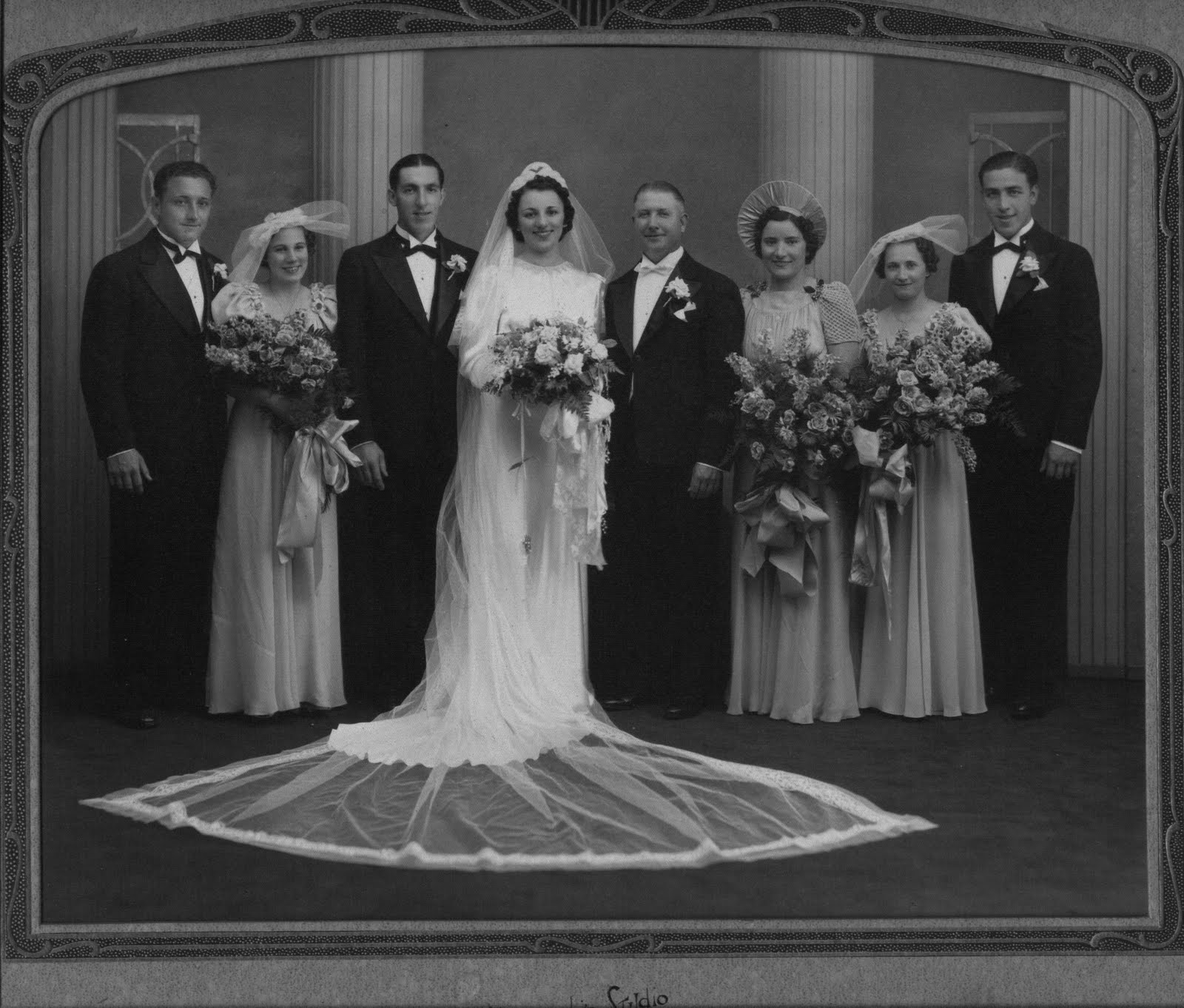
On this day back in 1939 (it was a Thursday that year), Marian Theresa Ghione took Ernest Salvo to be her lawfully-wedded husband, in sickness and in health, for richer or poorer, till death did they part.

Their Honeymoon took them to New York, where the infamous World’s Fair was underway. While up in that part of the Country, they visited the Fair, and made other stops as well, one being at Niagra Falls.

A year later, they would have their first child together, a son (Ernest J.). And shortly after that, 2 more children followed (Paul and Marianne). Their family of 5 shared many years of happiness together.

Today would be their 71st wedding anniversary, which comes just after a weekend-honorarium to both them, and their families, at the Winterthur museum in DE.

Although both of them have since passed on (Marian on April 8, 1968, Ernest on June 12, 1982), we have faith that they were re-joined after death and are now together in Heaven.

Felice Anniversario, Grandmom e Grandpop……………………………

Sunday, June 6, 2010

Celebrate Being Italian With Winterthur on Sunday, June 13th


This coming Sunday, June 13th, Winterthur will be having a "Celebrate Being Italian" day from 10AM until 5PM. Frank Rosaio and I will be on-site to share our knowledge and family histories, some special Italian items will be offered on the Winterthur café menu and many other surprises await as well! And don't forget, the Lost Gardens of the Brandywine exhibit is still on display (through July 25th).

For more information, click on the image attached with this post, or visit
www.winterthur.org